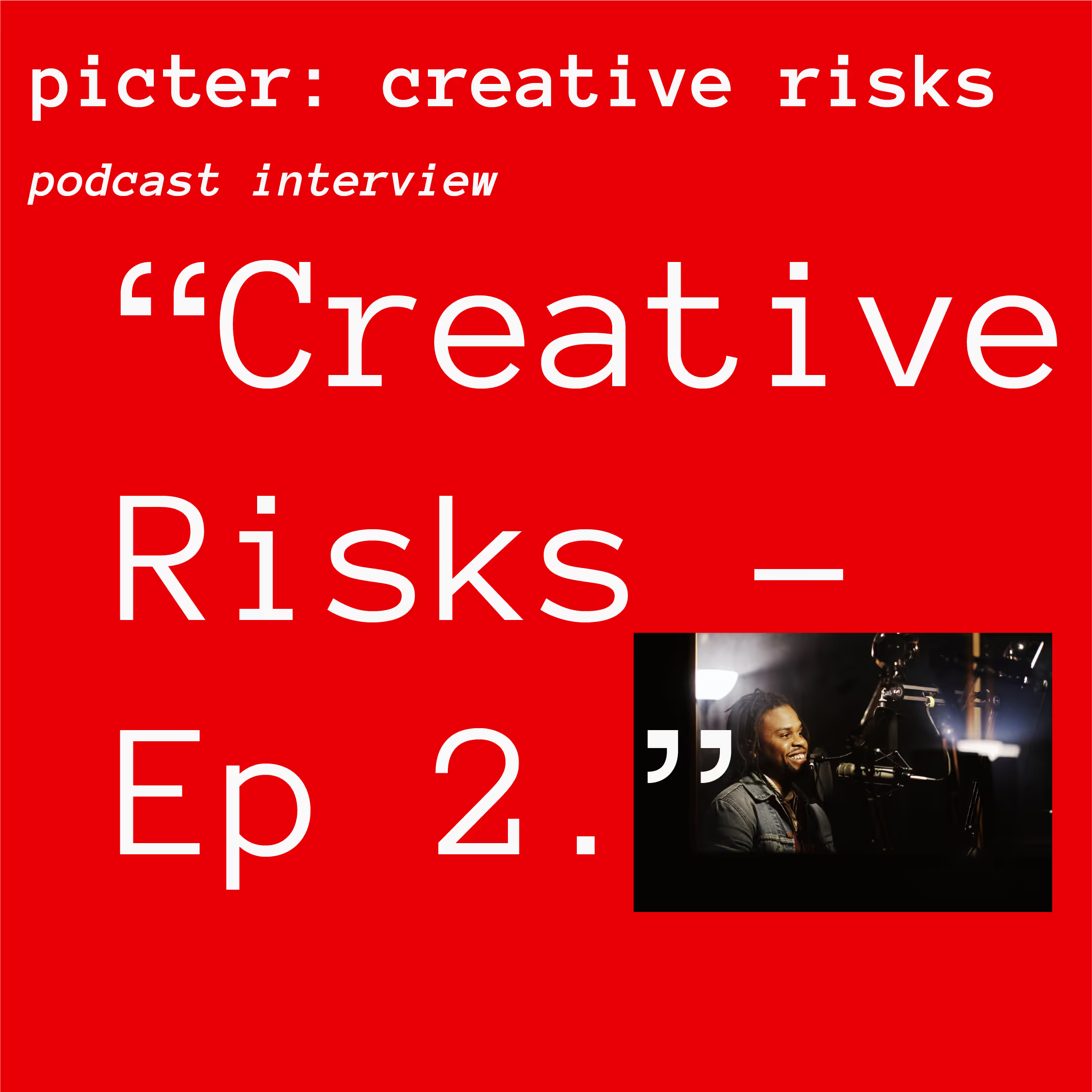
The Pause of Leadership: Lessons From Vipassana
Over Labor Day weekend, I disappeared into silence. Ten days, no phone, no calendar invites, no Thinkboi pieces. Just breath, body, and stillness. It wasn’t an escape from work; it was an act of leadership. A decision to refuel the intuition behind the output.
In a culture that rewards constant motion, hustle, and performance, I chose stillness. And what I came to realize is that sometimes the bravest move isn’t pushing harder; it’s pausing long enough to listen.
As creatives, thinkers, marketers, and operators, we are navigating one of the most disruptive moments our industry has seen: budgets are shrinking, AI is reshaping expectations, and media rights are shifting from traditional platforms to YouTube, streaming, and OTT.
We once had a “Triangle of Productivity,” which was a mafia-like code of conduct… We respected it and were confronted by it. Now we are in dark days, where we are being forced to redefine our relationship to the triangle’s points. Resulting in a disorienting space for us craftspeople and creatives.
Everyone, clients, editors, and strategists, are learning at the same time. The market is fragmented, noisy, and moving fast. And yet, in the stillness of Vipassana, I found some clarity.
Vipassana is simple in theory, brutal in practice. You sit for hours, breathing and observing the sensations on your body without reacting, without judgment. What starts as stillness turns into revelation.
Well-Being as Strategy
In silence, you realize how much our bodies carry: stress, ambition, expectations. At Platte Group, I’ve learned that healthy leaders build healthy teams.
Vipassana reminded me that equity isn’t a theory it is an act in this all:
- Everyone sits on the same cushion.
- Everyone eats the same meal.
- Everyone carries their own discomfort.
No privilege, no shortcuts. It reminded me that our workplace must operate the same way, rooted in equity, respect, and compassion. It also creates a clear value set to remind me when engaging with potential new client partners and vendor partners. If there are red flags that don’t align with those values, we must remain mindful and non-attached.
If someone on our team isn’t delivering, we don’t rush to blame. We ask “How are you?” We make space for the life experiences they carry with them. We support when needed. Because when people feel seen and cared for, the work reflects it.
Silence as Creative Fuel
Where does your creative inspiration come from these days? That Instagram group you’re in, Sora 2 Sponge Bob-scroll, TikTok-work colleagues, or your Gen Z ally? I’m projecting, those are a few of mine.
Silence is the key creative ingredient during these 10 days.
In the silence, I hear my life and work’s most challenging briefs bouncing off the walls of my mind; by day three, my intuition was unhinged.
Naturally, the most significant life challenges arise. I’ve never been one to look away… I swan dove in.
In silence, every idea has room to echo. By day three, my mind was a pinball machine of past projects, future pitches, and personal truths. This is creativity unfiltered, when your only tool is your awareness.
We scroll for inspiration, but true originality comes when you stop scrolling and allow your mind to actually process.
We’re all at risk of drawing inspiration from the same TikToks, the same awarded work, the same Instagram posts, the same trade headlines. But creative leadership means resisting the algorithm long enough to tap into something with substance.
During Vipassana, I had ideas for clients, for Palette Group, and for new business. All because I allowed myself to be quiet long enough to listen. Creativity doesn’t always live in the noise. Sometimes it lives in the pause.
Community as North Star
We’re moving into a chapter of Corporate America that will encompass more generations than we can count on one hand. We’re all pointing the finger at the next generation and how reckless and weird they’re making it. We just have to learn to process our own way of being and calibrate every generation and community’s culture.
Leadership, like meditation, is about managing the “I.”
- Craving control creates suffering.
- Avoiding discomfort creates stagnation.
- Centering the collective creates clarity.
Ego is a tool, not a compass. As Jay-Z said: “The same sword they knight you with, they gon’ goodnight you with.”
Leadership in Vipassana is also about taking responsibility for failure, both your own and your team’s. Creating the space for your intuition to reflect and respond in a way that feels accepting of the shame that may come with your failures. I’ve never gone to Business school, but I’m sure they don’t have a class on the shame we feel when having to make tough decisions or when we receive tough feedback. I know I never learned this in Art school.
So how did “I” handle reflecting on my WANTS AND NEEDS not being quenched for 10 days? I just sat there and breathed through it all, every “good” and “bad” thing people have said about me, every “good” or “bad” thought I’ve had in my own head.
I focused on removing the “I” from the words about me and just breathing through the thoughts and notions shared with me. They are all gifts, feedback, for my lived experience, personally and professionally.
Leadership isn’t about centering yourself. It’s about centering the collective. However, that ‘we’ can easily alienate a community, and that is when you have to account for ‘I.’ Leaders need to be accountable for understanding their team and articulating their vision in a clear and work-inspiring manner.
Stay reflective and vigilant on how your ego is being managed.
Presence Over Performance
Vipassana teaches you to observe without reacting. As leaders, that translates into presence over performance.
Old leadership solved through speed. New leadership solves through space.
In these rushed moments, leadership isn’t about forcing your team to grind harder. It’s about creating space. Holding the room long enough for a few breaths, and the right idea to rise.
On set this summer, a client said, “I don’t know if we’ll ever have a production like that again.”Not because of deliverables but because of how it felt: calm, collaborative, human.
Personal Thoughts
Again, this wasn’t a work Vipassana; I did this sit because I needed space to heal some tension. Personally, I know I can feel the tension that being in advertising and running a business puts on me. I’m not deluded enough to think I've fully processed the personal issues in my life that affect me at work. That is why I continue to do this healing work and translate it into professional work takeaways. Of course, I have so many personal takeaways I could share, but this is not the medium for that. If you’d like to learn more, please don't hesitate to reach out.
One last thing, when I think back to that old Triangle of Productivity, it once meant speed, quality, and cost. A balancing act that often left us stretched and reactive. But under the Pause of Leadership lens, the triangle feels different now.
I’ll leave you with this: How would you define your triangle of productivity today? What does it look like when you lead from pause, not speed?
If you’d like to explore the Vipassana for yourself, note that they are all donation-based and you can find them globally here: LINK



-Cover.avif)